 |
F O U R - S T R O K E C Y C L E
O T T O C Y C L E
|
|
V 1.0e (18.08.1998)
 diese
Seite in Deutsch
diese
Seite in Deutsch
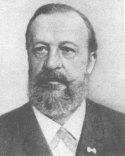
Fig
1: Nicolaus August Otto | Nicolaus
August Otto (Fig 1) the inventor of the four-stroke cycle was born on 14th
June 1831 in Holzhausen (Germany).
In 1862 he began first experiments
with four-strokes engines. Together with Eugen Langen he founded the first
engine company - "N.A.Otto & Cie". Then they improved the atmospheric
gas engine (Fig. 2) and in 1867 they won a gold medal at the Paris
Exposition. One of the first four-stroke engines is shown in Fig. 3. A
working diagram of this engine is shown in Fig. 4. It corresponds to the
today's engines. He died on 26th January 1891 in Cologne.
|
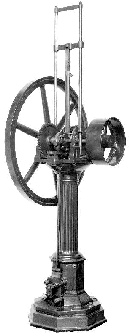
Fig 2: atmospheric gas engine- about 1866/67 |
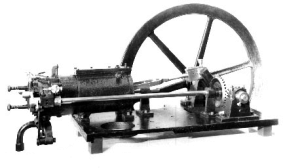
Fig 3: four-stroke cycle engine 1876 |
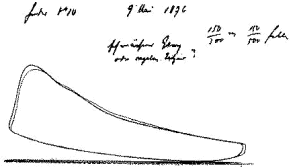
Fig
4: working diagram : 9th May 1876 |
(2) The Parts of the Engine |
|
| The figure at the right shows the main parts of
a simple four-stroke cycle engine. These are: the Intake Valve (IV), the
Exhaust Valve (EV), the Piston (P), the Piston Rings (PR), the Combustion
Chamber (CC), the Connection Rod (CR), the Crank Shaft (CS) and the Spark
Plug (SP). |
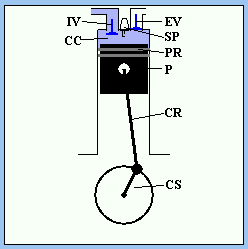
the parts of a
simple engine |
(3) The Cycle - Introduction |
|
A 4-stroke cycle engine carried out four piston strokes during one combustion
cycle - Intake Stroke, Compression Stroke,
Power Stroke and Exhaust Stroke. During the intake
stroke the intake valve is opened and the piston moves toward the crank shaft.
The movement of the piston creates a negativ pressure in the combustion chamber.
The air/fuel mixture is sucked into the chamber. If the Bottom Dead Center (BDC)
is reached the intake valve is closed and the piston moves upwards (compression
stroke). The air/fuel mixture is compressed. A short period before the Top Dead
Center (TDC) is reached the spark plug ignites the air/fuel mixture. Temperature
and the pressure into the combustion chamber increased rapidly. The hight
pressure drives the piston downward (power stroke). At the end of the power
stroke - at the BDC - the exhaust valve is opened. The piston is moved upward
and the gases in the combustion chamber will be pushed through the exhaust valve
(exhaust stroke).
(4)The Cycle - The Four Strokes |
|
If you have the ability to measure the pressure in the combustion chamber and
its volume during all four strokes you get a diagram like Fig. 6 (p-V diagram).
It represents the state of the gas in the chamber.
| The figures of the state of a simplified engine
as so as the corresponding p-V diagrams were taken form the Online
Animation of a Four-Stroke Cycle site. The single point shown in the
p-V diagram represents the common state. The color of the combustion
chamber indicates the temperaure (red: hot; blue: cold). |
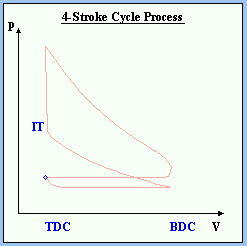
Bild 6: p-V diagram |
INTAKE STROKE
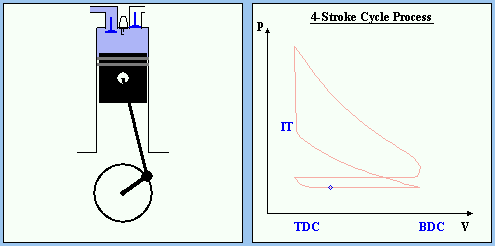
Fig 7: INTAKE
STROKE | The piston moves down the
cylinder and the pressure will drop (negative pressure). The intake valve
is opend. Because of the low pressure the air/fuel mixtures is sucked into
the cylinder. |
COMPRESSION STROKE
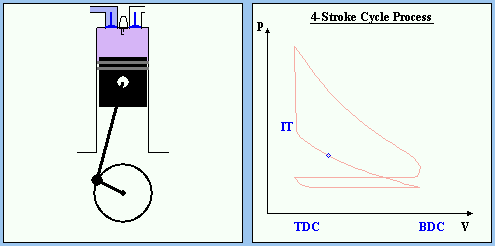
COMPRESSION STROKE | At
Bottom Dead Center (BDC) the cylinder is at its maximum volume and the
intake valve is closed. Now the piston moves backward the Top Dead Center
(TDC) and compresses the air/fuel mixtures. The pressure is increased and
the volume is decreased. The necessary work for the compression increases
the internal energy of the mixtures - the temperature is increased.
Because of the fast compression only a small part of the energy is
transfered to the environment. |
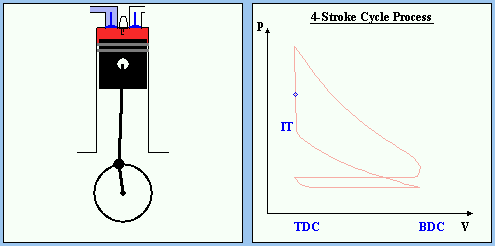
Fig 9:
IGNITION | Near the end of the
compression stroke, the ignition starts the combustion and the mixture
burnes very rapidly. The expanding gas creates a high preasures against
the top of the piston. The resulting force drives the piston downward in
the cylinder. |
POWER STROKE

Fig 10: POWER
STROKE | The force drives the piston
downward to crank shaft (the valves are closed). The volume is increased
and the preasure is decreased. No more energy is added and because of this
the internal energy of the gas is decreased as so as the temperature.
|
EXHAUST STROKE
| At BDC the exhaust valve is opend and the piston
moves up the cylinder. The pressure drops near the preasure outside the
cylinder because of the opened exhaust valve. Exhaust gas leaves the
cylinder. The volume is decreased. |
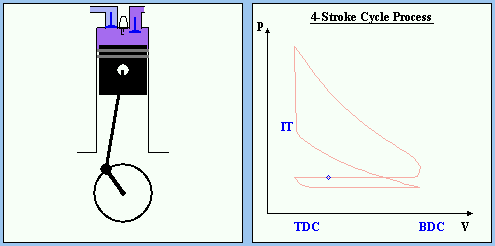
Fig 11: EXHAUST
STROKE |
There is a small WWW-site : Links & Literature - Four-Stroke Cycle Engines.

 ITC-Leipzig